Showing posts with label Sustainability. Show all posts

Monday, September 30, 2013

Homemade Applesauce


     Applesauce is so simple to make that it has dropped off my grocery list completely. Homemade applesauce is also much healthier than the store bought variety which contains high levels of sugars, including high fructose corn syrup. This post will focus on making homemade applesauce for serving, and a second post later will provide instructions for canning it for enjoyment during the off-season. 

While applesauce can be made with some spice like ginger or cinnamon, I prefer to keep mine fairly basic by letting the apples be the predominant flavor. Certain apples are naturally sweet, and so by selecting these varieties I can reduce the amount of sugar I need to add. A great chart for selecting apples can be found at Pick Your Own. When we have apples in the pantry, it's usually Galas which work well for sauce as well as eating. For my husband and I, I will use about 2-3 apples to make sauce. (The following instructions are for two servings, and so you may need to make adjustments to the quantity if you're serving more people). 

Peel and cut the apples into small pieces. The smaller the pieces the faster they will cook. 


Place in a pot and add about 1/4 c. of water. (The amount doesn't have to be precise. You're not boiling the apples like you would potatoes. The water is just to get the pieces cooking.)

Continue cooking until the pieces easily mash with a fork. For chunky applesauce, use a potato masher to blend. For smoother sauce, a Stick Hand Blender  is wonderful. (I rather like the chunks of apples, so I just get it mostly smooth.)


If you wanted to add sugar, cinnamon or any other flavors then add them now. Whether you add additional flavors or not, the final step is to simply chill and then serve. Enjoy!

Up Next: Canning Homemade Applesauce

Linked up at:


Wednesday, June 12, 2013

Handwashing vs. the Dishwasher (Part 1)


       Does handwashing dishes clean them as well as a dishwasher? Does a dishwasher cost more in terms of repairs and replacement or energy usage? There are a few areas such as cleanliness, cost, time and consistency that must be considered when determining which method of washing dishes is better. 

        Let's begin with cleanliness. According to Real Simple, a water temperature of 140° is necessary to kill bacteria. The hot water from the facet will not reach this temperature, and for a good reason- it would burn your skin. Based on water temperature, the dishwasher is superior at sanitizing dishes. However, bacteria can still be eliminated in the dishwater with the use of antibacterial dishsoap or a small amount of bleach. Each of these has a significant drawback, though. Bleach, for instance, poses significant health and environmental risk.   Antibacterial additives to soap has recently raised concerns as a contributing agent to a growing antibiotic-resistance in the environment. I do not use either of these substances in my dishwater. If a dirty dish has sat on the countertop or in the sink for a while which would promote bacterial growth, then I would use another method. For everyday meals, good ol' soap and water is sufficient to clean dishes in my opinion. 

        A second aspect in the dishwasher versus handwashing debate is the matter of cost. Both methods require some degree of cost. Handwashing dishes involves the expense of water usage multiple times a day. A dishwasher also requires the expense of water usage, as well as electricity usage and the cost of eventually needing to repair or replace the appliance.  With a price tag of about $300-500, the sudden expense of replacement can hit a family budget pretty hard. With regard to electricity use, an energy-efficient dishwasher uses only 1kwh of energy (source: Huffington Post). Lastly, the dishwasher uses less water than handwashing if the dishes have not been pre-washed prior to loading into the dishwasher. I have always thoroughly rinsed my dishes prior to loading them into the dishwasher because as a renter I haven't always been able to rely on the older dishwashers in the units. This practice, however, adds to the cost of using the dishwasher. 

      Convenience and time requirements are also a consideration. Automatic dishwasher have lessened the work and time required by domestic tasks. It would by far take more time and energy to wash every dish by hand after every meal. As wonderful as it is be alleviated of this demand, I also believe there is a great good than can come from not having a task completed for me. Great gains can be found in domestic work! For example, my grandmother once wisely told me that your more resourceful and appreciative of how you use your dishes to cook when you've had to spend time and effort bending over the sink to wash them. I find myself not as mindful and well..spoiled and lazy when it comes to caring for my possessions, including my kitchen dishes. 

      The last consideration is in regard to lifestyle. When I had a residence of my own prior to marriage, I would wash by hand because if not I'd run out of dishes before I could fill the dishwasher. Now, I cook full meals a few times a day and never lack in filling the dishwasher. Yet, I have a bad habit of leaving dishes for a later clean-up. By the time "later" arrives, I'm also needing to cook a meal but have little work space or cooking utensils. Or, someone drops by to visit and I'm too embarrassed of the mess to extend an invitation inside (our home has an open floor plan, so there's no avoiding the kitchen). I've discovered the best means of combating this bad habit of mine is to wash all the dishes after each meal. I tend to have so many dishes and cookware that are not dishwasher safe that I have to wash by hand even if I'm using the dishwasher. So, I decided to just wash everything by hand after each meal, and the kitchen stayed cleaner. (Of course, knives or cutting boards that dealt with meats or eggs were placed in the dishwasher anyways). Even though the dishwasher is more efficient, it's been more beneficial for me to develop better habits the old fashioned way. If you find yourself with piles of dirty dishes all the time, I suggest to begin washing by hand to: 1) develop a better mindfulness of your (over)usage during meal prep and 2) develop a better habit for keeping dishes caught up. In time, you can shift from the sink back to the dishwasher. 

Up Next: Part 2 (How to properly handwash dishes and load the dishwasher)


Tuesday, March 19, 2013

5 Simple Ways To Save Water


      One discovery that is made when you move frequently is that rates for utility services are not the same everywhere. I was rather shocked when I received our first water bill in our current home. I initially thought that perhaps we had gotten into poor habits of greater water consumption. However, after comparing our current usage with our usage at our previous residence I learned that despite the gallons consumed being the same our bill is 60% higher now than before. Ouch! I then determined to try to make some simple changes that would better conserve water usage in our home.

      Conserving water isn't just a matter of financial concern. It's also a matter of preserving the environment. Environmental concern can become pushed to the side when supply is seemingly abundantly available. However, the truth is that the supply is relatively small and the processes for purifying and transporting it are complex. According to the EPA:

      less than 1% of all the water on Earth can be used by people .. The rest is salt water (the

      kind you find in the ocean) or is frozen. Communities across the country are starting to
      face challenges in maintaining healthy and affordable water supplies; that's why it's more
      important than ever to use our water wisely and not waste it. In addition, it takes large 
      amounts of energy to produce and transport clean water and to process waste water.

      It's so easy to simply turn on the faucet and let the water run unnecessarily. Or, perhaps enjoy that hot shower a bit too long. These expenditures come at a cost. Interestingly, many times when an issue is unsustainable to the environment it is also unsustainable for my family budget. And so, my husband and I determined five very simple ways that we could begin to conserve water in our home.

5 Simple Ways to Conserve Water
1. Place a bottle of water in the toilet tank
      We used a 1 Liter water bottle. The water in the bottle displaces the water stored in the tank. The tank then uses 1 L. less water with each flush. 

2. Replace shower head with a water conservation/low flow head
     This was the one area that I was really hesitant to change. I was dreading having to shower with a low flow shower head that left me cold and with suds in my hair. But, we looked carefully at the various models available and purchased a multi-setting shower head that permits 2.0 gal/min. flow. It even has a drip setting for when you're not needing full water flow. Yet, we've found that this setting is sufficient to keep it on at all times. 
     Waterpik has a great calculator that can be used to determine the savings produced by investing in an "eco flow" shower head. According to the calculator, we're now saving  9,855 gallons of water! Hooray!

3.Shorten showers
     I will admit that I'm notorious for taking long hot showers. Nevertheless, we've set a goal to limit showers to 10-15 minutes. 

4. Rinse dishes in filled sink instead of running water
     I habitually rise my dishes before loading them into the dishwasher, which lessens the workload placed on my dishwasher. A lot of water is wasted by leaving the water running while rinsing each dish. Instead, I plug the sink to fill with a small amount of water. Since the dishes are merely being rinsed and then loaded into the dishwasher, I'm not overly concerned if the water gets a little dirty. Periodically, I let the water drain out and then refill. I actually save quite a bit of water this way.

5. Thaw frozen foods overnight instead of under running water
      The ideal method of thawing frozen foods like meat is placing it in a dish and then in the refrigerator for a period of time (typically overnight). When in a time pinch, an alternate method is to place the food under running water. Some foods, like fish, can take up to 15 minutes using this method. Yikes, the waste of water! A little thinking ahead and planning early for meals can prevent needing to resort to this unnecessarily consumptive method. 


Monday, October 22, 2012

The Family Car


Image Source

What is the value of each individual owning a vehicle? I began to toss this question around more and more this year. When my vehicle is predominantly sitting parked in the parking lot, then its necessity and alternate use for it’s worth comes to be questioned. Yet, I also considered what owning my own car represented- wealth, status, convenience, and even entitlement. We do not live in an area with public transportation or biking paths, and so I wondered if it would even be feasible for us to downsize to sharing only one vehicle.

There was a time in which families did share one vehicle- the family car. All driving members of the family had to make arrangements necessary to accommodate the needs or wants for its use. What allowed one car to be sufficient then but not now? Perhaps it has to do with expectation. As vehicle ownership increased in time so did the expectation for such. The seeming norm now is for each driving member of a family to have his or her own vehicle. In fact, it is not unusual for sixteen or seventeen year olds to be provided a vehicle of his or her own (but not necessarily true ownership). There are certainly many, many other factors at play for the greater possession of vehicles now in comparison to previous times. Expectation is simply one.
          
      After much discussion my husband and I made the decision to sell one of our two cars.  We weighed the pros and cons to making this rather big decision, and the following were the factors that were considered:

Advantages:
  • ·         Avoid costly maintenance/repairs.
  • ·         Financial stability
  • ·         Decreased insurance payments, taxes/registration/tags
  • ·         Option to replace two older vehicles for one more reliable one
  • ·         Eliminates a "yours" and "mine" mentality within our marriage
  • ·         Humility

Disadvantages:
  • ·         Inconvenience
  • ·         Lack of transportation in the event of an emergency
  • ·         Immediacy of purchase if a two-income situation were to be needed
  • ·         Judgment for choosing to live differently

     Ultimately, the advantages outweighed the disadvantages. We’re still discussing whether we want to trade in the remaining car for a newer vehicle. After finally achieving no car payments and one less debt, I’m reluctant to rush back into another one. Even then, we’ll continue to be a one car family. It takes a little more planning and intentionally if just one of us needs the car. Sharing a car also takes compromise. All of these qualities are good characteristics to develop personally and in a marriage. Sharing a car is simply another means of doing so.

Everyone’s situation and needs for transportation are unique, and I will certainly not assume that what has been appropriate for me and my husband is the same for others. If you are considering downsizing to one car, however, then I hope to encourage you with my experience.


        -*-*-*-*-*-*-*-*-*-*-*-*-*-*-*-*-*-*-*-*-*-*-*-*-*-*-*-


Wednesday, September 26, 2012

Homemade Yogurt

       Yogurt is a staple in our home. We use it in snacks, smoothies, breakfast parfaits, and as an ingredient substitution. There are many nutritional benefits to eating yogurt. When comprised of only the two basic components of milk and yogurt starter, you’re getting the nutritional offering of the milk plus the good bacteria found in the yogurt. Yogurt purchased in the stores is often times loaded with preservatives and sugars. There is also the issue of purchasing and throwing away all those plastic cups. My husband and I have since learned how to make a large batch of yogurt for a fraction of the cost. We initially used a slow-cooker method. My slow-cooker tended to get hotter in certain places and would scorch the milk leaving a mess of the milk and pot. So, we moved on from this method to the stovetop method. It does take some time to make yogurt at home. It probably takes me an hour from start to putting it away to culture, but I’m not standing over the pot the entire time. Now, let me show you why it may be worth finding an hour each week:
Cost to Purchase Ingredients: $4.73
Milk: $3.39/gallon & Yogurt starter: $1.34/6oz

Per Batch Cost: $1.07
Milk: $0.85/quart
Yogurt starter: $0.22/oz/2T

Purchased Yogurt: $1.34/6oz container

Unit cost
Homemade: $0.03/oz
Purchased: $0.22/oz

     In summary, we make one quart of yogurt for $1.07! If we purchased the near equivalent in 6oz cups we would need to buy 5-6 packages (@$1.34 each) which would total $6.70-8.04! I don’t know about you, but that’s a big difference for my grocery budget!

     I've found that the key to regularly including certain homemade foods is to make them part of your weekly routine. Pick a day of the week and make a particular food item that day. Keeping granola, breads, and yogurt on hand is much easier when I make making those items a part of life instead of setting aside life to make them. For instance, my hubby makes all our breads for the week on Sundays (he is amazing  at making breads). Finding time to do yogurt is similar. 


Steps:
(Keep in mind we're making only a quart for just my husband and I for a week. If you have a larger family, then adjust the amounts to fit your needs)

You will need: quart jar with lid, thermometer, whisk, 2 pots, 1 qt. milk (whole milk works best), and 2 T plain yogurt with active cultures (we like Chobani brand best). 

The first order of business is to sterilize your jar and lid. Simply place your jar and lid in the larger pot with water and heat to a boil. Allow to boil for a bit and then remove to a towel to cool. 

Next, heat your milk. This step is essentially re-pasteurizing the milk to make sure the only bacteria present to culture are those found in the yogurt starter. Heat the milk to 185˚F, and then hold it here for about 5 minutes. Then, cool the milk to 115˚F.

Add 2 tablespoons of yogurt to your jar. Add 1/2 c. of milk to the jar. Gently shake or stir to combine.  Then, add the remaining milk. This two step process allows your yogurt cultures to slowly rise in temperature to be able to safely tolerate the high temperature of the milk, so don't skip on this step. 

Replace the water in the large pot with as much cold water necessary to bring the temperature of the water to between  
90-100˚F. Place the filled quart jar in the water until submerged.  Leave the pot in the oven with the oven light on overnight to culture, approximately 8-10 hours. 

The next day, you have a quart of cultured yogurt! If you would like you can strain the yogurt at this point to have thicker, Greek-style yogurt with leftover whey or you can leave it as is. Sometimes I strain mine and sometimes I don't. If I'm going to be making a batch of granola then I might strain it to have whey to soak the oats. 

Uses:
     We currently use yogurt in making breakfast parfaits, smoothies (freeze the yogurt in cubes for a better smoothie result), snacks (add a spoonful of fruit preserves or fresh fruit for flavors), and as a partial mayonnaise substitution. My husband detests mayo. so I use half mayo and half yogurt in any recipe that calls for mayo. 

     Using yogurt as a substitution is also a good way to make the grocery budget stretch as it's cost is usually much less than the ingredient it's replacing. You can actually use yogurt in specific proportions in place of butter, oil, sour cream, mayonnaise, cream cheese, and buttermilk! Chobani's website has a lovely infograph conversion table of these substitutions.

*Note: Reviving Homemaking is not an affiliate of Chobani and has not been asked or persuaded in anyway to promote this brand. It's simply a brand that I have been pleased with in my own experience, and therefore wish to share with others. 

Linked up at: 
 
        -*-*-*-*-*-*-*-*-*-*-*-*-*-*-*-*-*-*-*-*-*-*-*-*-*-*-*-


Thursday, August 2, 2012

Shucking the High Cost of Summer Drought


     My husband and I recently took a trip and all along the way the above scene was what we saw. Corn fields ought to still be green this time of year, but this year's extreme hot and dry weather has devastated crops. This situation isn't unique to the few states we crossed as it can be found all across the country. Taking into consideration that one fourth of products on store shelves ranging from foods to toiletries contain an ingredient derived from corn (3), not to mention the use in animal feed and automobile fuel, the impact will soon be evident by means of higher prices on an extraordinary amount of products we all consume. There are other crops that have been impacted by the drought. However, because corn is the largest crop grown and most diversely used it will be the one that the most attention will be given. There are a few ways to lessen the toll increasing prices will have on the family budget. Some tips will be appropriate to do now before the prices increase such as stocking up while supply and prices are still good, and others can be done when the true need arises.

Groceries
     Groceries will be the biggest area to see high prices. Three quarters of our grocery products contain a corn-derived ingredient (5). These components can be found in nearly every packaged/process/convenience food. Moreover, animal feed is comprised of corn or corn products. As a result, meat and dairy products are expected to also increase as high as up to 10%(5)
Suggestions:
     ~Make the shift from packaged/processed/convenience food products to real/whole foods. Begin learning how to work with raw ingredients to create meals yourself. In essence, take a back to basics approach when it comes to food and meal preparation. You'll be surprised at how much you'll be able to do with your own hands! Familiarize yourself with corn-derived ingredients and select other options whenever possible.

     ~Prices aren't expected to increase until the end of 2012 or beginning of 2013 (5 & 6), and so take advantage of the prices currently in meats by stocking up in your freezer. Keep in mind that not all meats have the same life in the freezer. For instance, ground meat will keep well for up to three months while steaks and roasts will last up to six months. 

     ~If you can afford it, select grass-fed meat and dairy products. Although these animals aren't given corn in the same fashion as conventional animals, there may still be a price increase. Grass-fed meats and diary products are a better choice regardless of conditions, but are very pricey. If you can allot for it in the budget, then this would be a good time to go for it. If not, then wise use of whatever you can afford is best.

     ~Decrease consumption of meat or dairy products and supplement with vegetarian options. Plan menus to include meatless meals. Use beans and quinoa for a protein source.  You don't necessarily have to cut out meat or dairy products entirely because prices will be high. Just find a balance between meat meals and veggie meals. (My hubby is a meat-lovin' man, but we've done half meat and half mealtless meals each week and been satisfied in doing so. It is possible to do even if your man loves meals with meat as the main portion).

Automobile Fuel
     Changes in the price of crude oil as well as corn-derived ethonol will impact the gas prices.
Suggestions: The greatest strategy here is to apply ways to conserve gasoline usage.

~  Maintain your vehicle and tires in optimum condition.

~ Limit how much you drive by skipping trips or doing your errands all at once. Not only will you save in gas, but also in the wear and tear of your vehicle!
     
Electricity
      Electricity costs increase during a drought. Unlike the corn related issues stated above, higher electricity costs result from a decrease in water used to cool the generating plants and excess work required to keep your home cool in high temperature weather. My husband and I have seen this result in our bill compared to last year and you probably have too. 
Suggestion: The greatest strategy here is to again apply ways of conserving. 
     
~Set your thermostat to the highest tolerable temperature. Attempting to keep a 70 degree or less home in 100+ degree weather is tough on the system. You don't have to sweat in your own home, but if you need a sweater then perhaps bump up the setting.
     
~Use heat generating appliances early in the morning or late at night. The oven, stove, clothes dryer etc. put out heat that warms your space and causes your air conditioning to kick on more frequently. Simply, move the time of day you conduct this activity. On extremely hot days, plan salads for meals to give the stove a break. Also, clothes dried outside save a lot of energy not to mention leaving them sun-bleached and fresh smelling!


       All of the above are simply suggestion for how to lessen the impact that is expected to be had from this year's drought-ridden corn crop. Yes, the prices will likely go up but these things generally do fluctuate. The best tip of all is to not panic. Following just a few of these tips will help you to not feel the impact as much. Choose what is appropriate for your family. If you notice, all of the mentioned suggestions are valid regardless of the external conditions. It's wise to conserve and be mindful of what we consume regardless of economic/agricultural prosperity or decline. In fact, doing so during a plentiful time will allow you to better handle a time of less. 

Additional reading:
1. Corn-Derived Ingredients
2. List of Corn Products (click "Corn Products" under the header "Market")
3. Issues in American Commodity Farming
4. In a World Without Corn...
5. How the Drought Will Affect Consumers (and What You Can Do About It)
6. How the Drought Will Cost You


Linked up at:Your Thriving Family, Thankful Homemaker, Growing Home, A Mama's Story, The Alabaster Jar, Homestead Revival, The Better Mom, Covered In Grace, Raising Arrows, Deep Roots at Home


-*-*-*-*-*-*-*-*-*-*-*-*-*-*-*-*-*-*-*-*-*-*-*-*-*-*-*-


Saturday, June 16, 2012

Creative Gift Wrapping: Thinking Outside the Roll


     Newspaper can actually provide a creative and fun medium for wrapping gifts. The bow is what really makes the presentation complete (instructions below). I think this style makes a great option for gift wrapping for men, who are generally not as impressed with a lot of frills in presentation. It could also be a frugal way of wrapping if need be. I think the newspaper made a superb gift wrap for this year's Father's Day gift.  

Create a Paper Bow

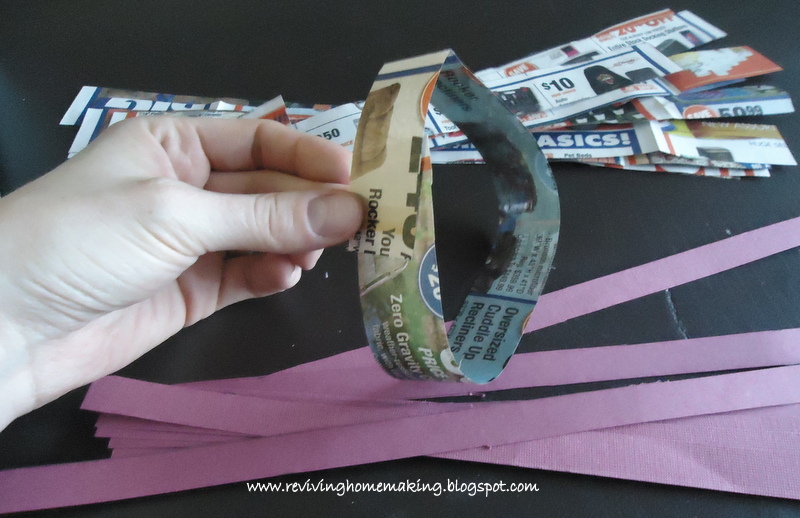
Wrap gift as normal, but with a sheet of newspaper. Then cut several (12-15) 1" strips of newspaper, and several (12-15) more strips of colored paper 1/2" in width. A sales circular generally provides a more colorful bow to set it apart from the text of the newspaper wrapping. 

Form a ring with the strips.

Bring the back to the front and tape/glue/stable to join. 

Using a needle and thread, pierce the center of each folded strip and begin stacking them while alternating the sales circular pieces and colored paper pieces. 

Use the same colored paper to create a little tag. Finished!

-*-*-*-*-*-*-*-*-*-*-*-*-*-*-*-*-*-*-*-*-*-*-*-*-*-*-*-


Related Posts Plugin for WordPress, Blogger...